Knock Fever
Kite Games ASPuzzle
4.6225.00 Reviews
- Version
- 2.4.0
- Installs
- 500.00K
- Age Rating
- Everyone
Screenshots
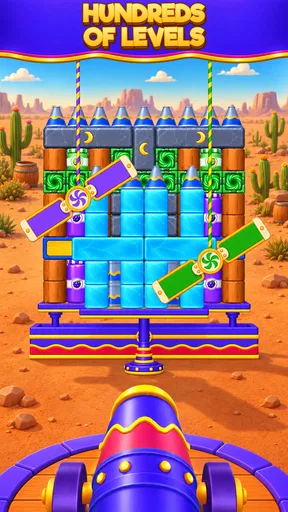
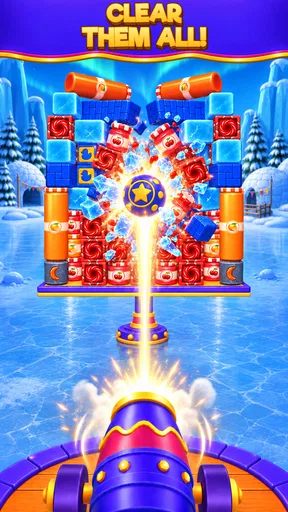
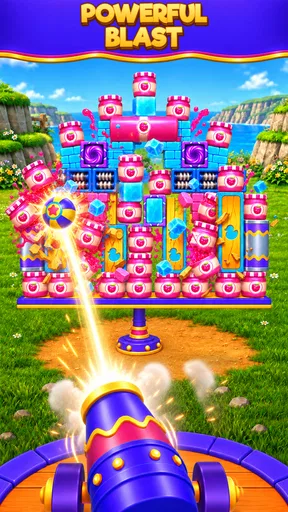
Our Review of Knock Fever
 Analysis by Appyee
Knock Fever is the kind of puzzle game I reach for when I want a quick burst of action without learning a complicated control scheme. The idea is easy to understand: aim powerful cannon shots at towers, break them apart, and work toward clearing each level. That simple setup gives the game an immediate goal, but the real question is whether knocking down structures stays satisfying after the first few rounds. In my experience, it does best when I treat each stage as a small problem to solve rather than as something to rush through.
Developed by Kite Games AS, this free game sits in the puzzle category and is suitable for Everyone. It has attracted more than 500 thousand installs and holds a 4.6 average from around 16 thousand ratings, which suggests that its straightforward destruction-focused play has found a sizeable audience. The current release is version 2.4.0, and it runs on Android 7.1 or later. There are optional in-app purchases ranging from $0.99 to $199.99 per item, so the free entry point is appealing, but I would still approach the purchase options carefully.
How the first levels establish the goal
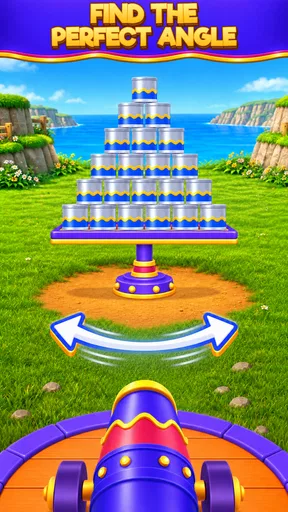
The opening appeal is immediate. I see a tower, I have a cannon, and my task is to make each shot count. That clarity matters because puzzle games can sometimes bury their main idea beneath menus, currencies, or long tutorials. Here, the central objective is understandable from the start: use controlled blasts to bring down the target and move through the level sequence.
That early goal works particularly well for short sessions. If I have a few minutes while waiting for an appointment or taking a break from work, I do not need to remember a large story or manage a complicated collection of characters. I can start with the physical puzzle in front of me and focus on the next shot. The game’s identity comes from the relationship between aiming, impact, and collapse, not from a large amount of surrounding explanation.
The first useful habit is to resist firing immediately. A tower may look as though its upper section is the obvious target, but the better opening can be a lower support or a point that affects several connected pieces. I found that taking a moment to read the structure makes the result feel more deliberate. This is one of the ways the game moves beyond simply tapping at whatever part of the tower is easiest to see.
That small pause also gives the early levels a gentle learning function. I learn to look for weak points, notice how the tower is arranged, and think about whether one shot can create a larger collapse. The game does not need a long explanation to communicate that lesson. The tower itself becomes the tutorial, and every successful impact shows me a little more about how to approach the next one.
For players who enjoy immediate feedback, this is a strong beginning. The premise is more active than a traditional tile-matching puzzle, yet it still asks for observation before action. It can also suit younger players and casual users because the age rating is Everyone and the basic objective is easy to explain. Someone looking for a deep narrative or a large strategic campaign may find the opening too bare, but that simplicity is part of its charm.
What makes progress feel visible
Progress in a game like this depends less on a complicated character build and more on whether each cleared level feels like a meaningful step. Knock Fever communicates advancement through the sequence of towers and the increasing need to think about shot placement. I enjoy that the reward is tied directly to solving the physical puzzle: the structure falls because I understood where to hit it, not because I waited for a timer or collected enough unrelated items.
The clearest progress signal is my own changing approach. At first, I tend to aim at the most exposed section. Later, I start checking the base, the balance of the structure, and the likely path of the blast. That personal improvement gives the early progression more value than a simple chain of identical demolitions. Even when a level is short, it can show whether I am beginning to read the tower more intelligently.
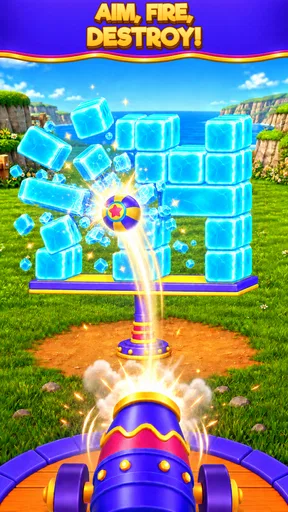
I also appreciate that the game’s central action creates a visible before-and-after moment. A standing tower is a problem; a collapsed tower is a result. That makes each attempt easy to understand, which is useful for players who dislike vague objectives. It also makes the game suitable for sharing a device casually with a friend or family member: one person can suggest a target, while the other decides whether to follow that advice.
There is a trade-off here. A puzzle built around repeated cannon shots can make progress feel less varied than a game that introduces new rules, characters, or environments. If every stage asks for essentially the same kind of judgment, the satisfaction may depend heavily on how much I enjoy the destruction itself. The game is strongest for people who like refining their aim and spotting structural solutions, not for those who need constant changes to the underlying formula.
A practical way to keep the progression interesting is to set a personal goal for each attempt. I might try to clear a tower with fewer shots, choose a safer target instead of the fastest-looking one, or pause after a failed attempt to identify the exact mistake. These self-imposed targets make the level sequence feel more active, especially when the basic objective has already become familiar.
Where the difficulty begins to matter
The difficulty curve works best when a tower looks simple but punishes careless aiming. The early challenge comes from learning that a direct hit is not always an efficient hit. As I become more comfortable, the puzzle value shifts toward planning: which section should fall first, where will the cannonball travel, and how much of the structure can one impact influence?
That change is important for pacing. If every tower could be solved by firing at its largest visible section, the game would quickly become a reflex exercise. The more interesting moments come when I need to compare two plausible targets. One may produce an immediate break, while the other may destabilize the entire structure. The better choice is not always visually obvious, and that uncertainty gives the shot real weight.
I would not describe the game as a demanding strategy title. Its appeal is more focused and accessible. The decisions are compact, and the result arrives quickly. That makes it easier to enjoy than a long-form puzzle game when I am tired, but it also means players seeking elaborate multi-step logic may reach the limits of the format sooner.
My main advice is to treat failed shots as information rather than as wasted time. Notice whether the problem was the target, the angle, or the timing of the attempt. If the tower remains mostly intact, repeating the same shot is unlikely to help. A better approach is to change one variable at a time so I can understand what caused the previous result. That method turns frustration into a small experiment.
The cannon mechanic also creates a useful tension between certainty and opportunity. A safe shot may remove a small part of the structure, while a riskier shot may trigger a much larger collapse. I like having that choice, but I do not always want to gamble. When I am playing casually, I prefer a reliable solution; when I am replaying a level for a better personal result, I am more willing to try the ambitious angle.
This is where the game’s puzzle identity separates it from a purely destructive arcade experience. The visual impact may attract me, but the lasting interest comes from deciding how to create that impact. Players who enjoy experimenting with physics-like outcomes should find more to think about than the store summary alone suggests. Players who want precise, rule-heavy logic may prefer a conventional brain teaser with less emphasis on spectacle.
Does the pacing encourage another level?
Knock Fever has a naturally convenient rhythm because its main activity is divided into individual tower challenges. I can play one stage and stop without feeling that I have abandoned a long mission. That makes it a good fit for commuting, short breaks, or a quiet evening when I want something interactive but not demanding. The quick loop also makes it easy to return after a few days away because the objective is simple to remember.
The same compact pacing can create retention pressure. Once I understand the basic shot-and-collapse loop, I need the structures themselves to keep offering new decisions. If a sequence feels too predictable, the attraction becomes dependent on the pleasure of knocking things down rather than on discovery. That is not necessarily a flaw, but it defines the audience: this is better for people who enjoy repetition with small tactical variations than for players who require a major new mechanic every few minutes.
The free price lowers the barrier to trying it, which is useful when I am unsure whether the loop will hold my attention. At the same time, the listed purchase range is broad, from $0.99 to $199.99 per item. I would recommend checking the purchase screen carefully and deciding in advance whether I want to spend anything. The game is easiest to evaluate when I judge the core puzzle loop on its own rather than assuming optional purchases are necessary for enjoyment.
That point matters especially for families. Because the content rating is Everyone, the game may look like an uncomplicated choice for a shared device, but the presence of in-app purchases still makes device-level purchase controls sensible. I would let a child try the free experience first, explain that the cannon puzzles are the main activity, and avoid treating paid options as part of the basic progression unless I had a clear reason to do so.
There is also a useful distinction between replay value and simple continuation. Continuing to the next level is enough for a relaxed player who wants a steady stream of short challenges. Replay value is stronger when I return to improve my decision-making, test a different target, or find a more efficient collapse. If I only want new environments and dramatically different rules, the game may feel less rewarding over time than a larger puzzle collection.
Who will enjoy it, and who should pass
I would recommend this game to someone who likes tactile puzzle solving, quick attempts, and the satisfaction of seeing a plan produce a visible result. It is particularly suitable for casual players who do not want a large commitment. The controls and objective are approachable, while the tower layouts give enough room for thoughtful aiming to matter.
It is also a good choice for players who enjoy learning through trial and error. A failed shot is easy to understand, and the next attempt can be adjusted immediately. That makes the game less intimidating than a puzzle title that expects me to memorize complex rules before I can make progress.
I would be more cautious about recommending it to someone who wants a story-driven campaign, character development, or a broad collection of puzzle types. The appeal is concentrated around cannon shots and tower destruction. If that central interaction does not feel satisfying after the first session, additional play is unlikely to change my opinion dramatically.
It may also be a poor fit for players who dislike optional purchase prompts or who prefer games with no spending considerations at all. Since the game is free but includes items priced from $0.99 to $199.99, I would make that part of the decision before installing it. A completely purchase-free minimalist puzzle would be a better alternative for that audience.
How it compares with familiar puzzle alternatives
Compared with a tile-matching game, Knock Fever feels more deliberate and physical. I am not scanning a grid for identical pieces; I am looking at a structure and choosing an impact point. That makes each successful move feel closer to solving a small demolition problem. The trade-off is that the variety of decisions may be narrower than in a match-based game with several special pieces and chain reactions.
Compared with a traditional logic puzzle, it is faster and more forgiving. I can learn from the result of a shot without spending a long time filling in a grid or tracking several conditions. However, the game may not provide the same depth for players who enjoy deduction that can be worked out entirely in the mind. Its satisfaction comes from combining visual judgment with immediate action.
Compared with physics-based destruction games, it appears more focused on level completion than on free experimentation. That focus is helpful when I want a clear objective, but it may disappoint anyone looking for an open sandbox where I can build elaborate chains without a defined target. Knock Fever works best when the tower is a puzzle to solve, not merely an object to smash.
Those comparisons helped me place the game accurately. It is not trying to replace every kind of puzzle experience. Its strongest space is between a casual arcade game and a light structural puzzle: more thoughtful than random tapping, quicker than a long logic challenge, and more goal-oriented than a pure destruction toy.
My verdict on the progression and staying power
After spending time with it, I think the progression succeeds when I pay attention to the tower rather than treating every level as a button press. The early goals are clear, the falling structures provide immediate feedback, and the challenge grows through better target selection and shot planning. Those elements create a satisfying learning curve without making the game feel inaccessible.
The limitation is equally clear: the long-term experience depends on how much variety the individual tower problems provide and how much enjoyment I get from improving my aim. The game does not need a complicated progression system to be fun, but it does need each new challenge to make me reconsider my previous habits. When it does that, I want to continue. When it does not, the loop can feel repetitive.
For a free puzzle game from Kite Games AS, I find the entry point appealing and the core idea easy to recommend. I would install it for short, focused sessions, especially when I want a game that gives me an objective immediately and lets me see the result of my decision. I would not choose it as my only puzzle game, but it earns a place alongside deeper logic games and more varied arcade alternatives.
My final recommendation is simple: try Knock Fever if the thought of finding the right cannon impact sounds more satisfying than matching tiles or solving a long written puzzle. Keep your shots deliberate, use failed attempts to study the tower, and treat the free version as the real test of whether the collapse-based loop holds your attention. For casual puzzle fans, that focused rhythm can be exactly the right kind of uncomplicated challenge.
Verdict
Strengths of Knock Fever
- Quick, easy-to-learn gameplay suited to short sessions.
- Bright visuals and energetic presentation make matches engaging.
- Simple controls are accessible for casual players.
- Increasing challenge gives the game a clear sense of progression.
- Works well as a lightweight time-killer on mobile devices.
Limitations of Knock Fever
- Gameplay may feel repetitive after extended play.
- Difficulty spikes can make later stages frustrating.
- Limited depth may not satisfy players seeking complex mechanics.
- Frequent retries can become monotonous without more variety.
- Performance may vary on older or less powerful devices.
Other Releases by Kite Games AS
View All
Beach Bliss: Merge Puzzle
Puzzle4.3
Similar Picks in This Category
View All
Block Blast!
HungryStudio4.8

Braindom: Brain Games Test
Lahana Game Studio4.6

AMAZE!
CrazyLabs LTD4.6

Sudoku - Classic Sudoku Puzzle
Oakever Games4.7

Art Puzzle - Puzzle Games
Easybrain4.8

Amaze GO!
Oakever Games4.9
Frequently Asked Questions
What is Knock Fever and how does the game work?
Knock Fever is a casual action game focused on timing, quick reactions, and knocking out targets or opponents through short interactive challenges. Gameplay is generally easy to understand, making it suitable for quick sessions, although later stages may require more precise taps and better timing. Before downloading, check the current store description because objectives, modes, and available features may vary between versions.
Is Knock Fever free to download and play?
Knock Fever can typically be downloaded without an upfront purchase, but free access may be supported by advertisements, optional in-app purchases, or both. Some items, bonuses, retries, or cosmetic content may be offered through paid transactions. We recommend reviewing the game’s store listing and checking purchase restrictions on your device, especially if children may use the application.
Does Knock Fever require an internet connection?
The basic gameplay in Knock Fever may work without a constant internet connection, which is convenient for short sessions while traveling or when mobile data is unavailable. However, advertisements, updates, online rankings, cloud-related features, or purchases may require connectivity. Availability can depend on the installed version, so test the game offline after installation rather than assuming every feature will function without internet access.
Is Knock Fever suitable for children?
Knock Fever’s simple controls and fast, arcade-style gameplay may appeal to younger players, but suitability depends on the game’s current content, advertising, and purchase options. Parents should check the age rating, privacy information, and permissions shown on the Android or iOS store page. It is also wise to enable parental controls, since advertisements or optional purchases may appear during play.
What should I check before downloading Knock Fever?
Before installing Knock Fever, verify that your device meets the required operating-system version and has enough free storage for the game and future updates. Also review recent user ratings, developer information, privacy practices, permissions, and whether the game contains ads or in-app purchases. Download only from the official Google Play Store or Apple App Store to reduce security risks and receive legitimate updates.
Play our best games!


